Maasai (Masai) People Traditions & Culture

TRIBES PEOPLE GROUPS - Maasai (Masai) ( Also spelt Maasai (Masai), Maasai (Masai)
The Maasai (Masai) could be the most known
Kenyan tribe outside Kenya especially for tourists The Maasai
(Masai) are more commonly associated with Kenya, but they've been a
presence around the Ngorongoro Crater of Tanzania for over a 150
years and are the area's main residents. They
are predominantly a warrior tribe whose lives revolve around
herding cattle. They believe the rain God Ngai entrusted the cattle
to the Maasai (Masai) people when the earth and
sky split, and wealth is measured in number of cattle. Since cattle
was given to the Maasai (Masai), they believe its okay to steal
from other tribes.
They believe the rain God Ngai entrusted the cattle
to the Maasai (Masai) people when the earth and
sky split, and wealth is measured in number of cattle. Since cattle
was given to the Maasai (Masai), they believe its okay to steal
from other tribes.
A stereotypical image most people have of
the Maasai (Masai) warrior is that of a tall and
slender man clutching a spear in one hand with his red cloth
wrapped around his waist or over his shoulders. The Maasai
(Masai) men are also seen in a trance like state jumping
in a uniform motion in one spot, this brings them to a trace like
state and can go one for hours.

The Maasai (Masai) drink cows blood that they believe makes the body stronger and warmer and is good for children and the elderly to build up their strength. It is often drunk mixed with the milk of the cow. An arrow is shot at close range to puncture the jugular vein of the cow. The blood is drawn into a skin gourd and later mixed with milk to be drunk by the gathering. The animal is not left to bleed but is carefully tended to, till it fully heals. Their rites and traditional ceremonies are taken very seriously, and it is not common to allow outsiders to attend. Elders play a very important role in the community and society at large.
People of the Maasai (Masai) tribe live in
small settlements of 8-15 huts per village; the kraal (a
traditional house or hut) is surrounded by a thorn bush fence,
which acts like barbed wire, protecting the tribe and animals
against enemies. The huts are built using branches, twigs and grass
with a cement of cow dung and urine, and inside animal skins and
cushions of dry grasses are used for comfort. The mixture is as
strong as cement after it dried in the sun and does not smell.
 They cannot stand up
straight inside the hut and the only openings are that of the
doorway and a small opening in the roof or wall which allows smoke
from a continually blazing fire inside to escape. Dried cow dung is
used to fuel the fire. The family sleeps on beds of woven branches
cushioned with dry grasses and animal skins.
They cannot stand up
straight inside the hut and the only openings are that of the
doorway and a small opening in the roof or wall which allows smoke
from a continually blazing fire inside to escape. Dried cow dung is
used to fuel the fire. The family sleeps on beds of woven branches
cushioned with dry grasses and animal skins.
Maasai (Masai) women and girls have numerous
chores besides building the dung hut, which take about 7 months. It
is their responsibility to milk the cows and fetch water, whatever
the distance may be. The Maasai (Masai) women are
also expected to pick calabashes or gourds from vines and clean the
insides of the gourds as well as decorate them with leather and
beads. A woman is by birth a member's of her father's family line
and cannot own land or cattle. They are minors in society,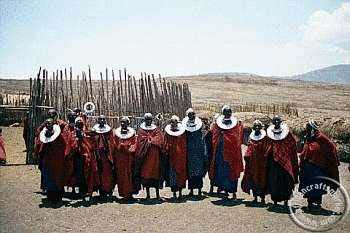 always represented
by their father, and later their husband. If a woman has no sons in
her marriage she will be scorned and forced to beg in her old age,
as she will have no possessions or money and no one to care for
her.
always represented
by their father, and later their husband. If a woman has no sons in
her marriage she will be scorned and forced to beg in her old age,
as she will have no possessions or money and no one to care for
her.
For the boys, fifteen is the coming of age ritual, when they become circumcised and become Morani (young warriors), formally they would hunt a lion with a spear during the rites of passage ceremony but lion hunting is now illegal.
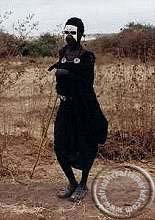 Children of the tribe have
importance in rituals like rainmaking during a drought when the
children sing for the rain. Playing "sheep's and goats" is a common
game for children, an equivalent of "cowboys and Indians". Teenage
boys make trouble playing with the cattle and playing "knock down
ginger" with a cow replacing the door! They are known for their
tradition of hair plaits, heavy iron necklaces, and fierce
warriormanship, often depicted carrying a spear. The Maasai
(Masai)'s unique hair is a clear living symbol of their
tradition and culture. By wearing the plaits, it proves the
individual is a true Morani sticking to their own traditions.
Children of the tribe have
importance in rituals like rainmaking during a drought when the
children sing for the rain. Playing "sheep's and goats" is a common
game for children, an equivalent of "cowboys and Indians". Teenage
boys make trouble playing with the cattle and playing "knock down
ginger" with a cow replacing the door! They are known for their
tradition of hair plaits, heavy iron necklaces, and fierce
warriormanship, often depicted carrying a spear. The Maasai
(Masai)'s unique hair is a clear living symbol of their
tradition and culture. By wearing the plaits, it proves the
individual is a true Morani sticking to their own traditions.
Nowadays, Maasai (Masai) boost their income by selling beads, masks, and carvings to tourists. In a curious way, tourism helps the Maasai (Masai) to retain and develop the Maasai (Masai) culture by transforming their believes into a business. The ceremonies you will see being performed as a visitor are traditional but they are staged for the tourist audience. It doesn't destroy the Maasai (Masai) culture because the tourists don't change the fundamentals of Maasai (Masai) living, only observe, whilst helping to rejuvenate centuries old customs.
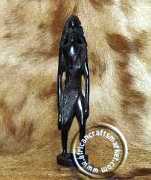
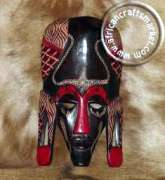
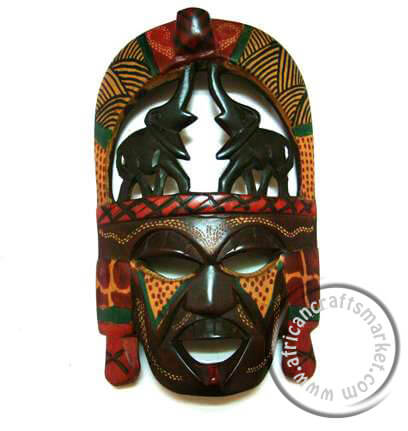
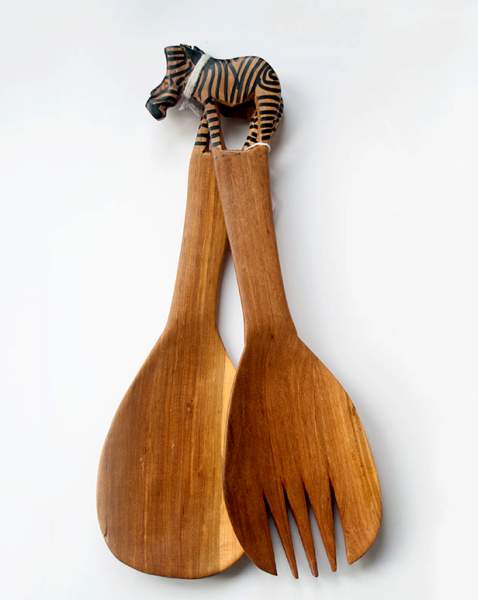

A selection of African Masai crafts on African Crafts Market
Click here Learn about more African tribes and traditions
The Ashanti tribe ~ The Bushman tribe ~The Maasai (Masai) tribe ~The Ndebele tribe ~The Shona tribe ~ The Teke people / Kidumu tribe ~The Zulu tribe
AFRICAN CRAFTS MARKET is a company situated in South Africa that has many Zulu pieces of art available for sale, from the lovely Zulu bead work and grass weave baskets through the traditional Zulu shields. To view the items that may be of interests to you go to our gallery pages on our website at www.africancraftsmarket.com



Shopping Cart
View shop-cart/checkout
Search
Website currency
Prices in US$
Shop Products
- Abstract art
- African figures
- African heads
- Animal skins
- Bead work
- Belts
- Candles
- Candle holders
- Canes
- Chessboards
- Clothing
- Cooking utensils
- Cushions
- Drums
- Footwear Shoes
- Furniture
- Gemstones
- Hats
- Horns & skulls
- Jewelry
- Leather
- Lights & Shades
- Masks
- Ostrich eggs
- Paintings
- Stone animals
- Stone Eggs
- Stone tableware
- Table cloths
- Wire art
- Wood animals
- Wood tableware
- Woven baskets
- Zulu shields
- .

Useful Links

Featured Item


Info
We work with crafters throughout Africa to find a vast range of handcrafted items and then send them worldwide.
All items are produced in Africa by local Africans
